

Turtle tank heaters need enough power for the enclosure, a dependable temperature control, and secure placement in a wet aquatic environment. The six options here cover compact desktop tanks through large 100- to 180-gallon setups, with several designed specifically for turtle habitats. You’ll find a useful fit whether you’re setting up a small aquarium, maintaining a mid-sized turtle home, or managing a large tank where probe placement and cord reach matter.
The Picks In Brief

hygger Mini Fish Tank Submersible Heater 20W
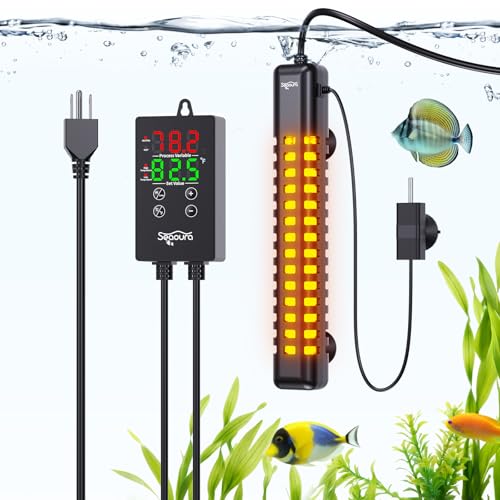
SEAOURA 200W Aquarium Heater for Turtle Fish 30-40 Gallon Tank

SEAOURA 800W Aquarium Heater for 100-180 Gallon Tank

AQUANEAT 50W Fish Tank Heater with Digital Thermometer
SEAOURA 300W Aquarium Heater for 50-60 Gallon Fish Turtle Tank
SEAOURA 500W Aquarium Heater for 70-80 Gallon Fish Turtle Tank
The Strengths Of Each Pick
A desktop aquarium leaves little room for oversized equipment, and the hygger’s 20W rating suits enclosures from 1 to 5 gallons. Its external digital controller makes the setting visible without keeping your head over the tank, which is convenient on a crowded shelf or office desk.
This is primarily a betta and desktop-aquarium choice rather than a capable turtle-tank heater. You may include it for a juvenile turtle in a very small habitat, but the limited output gives you much less margin than the SEAOURA models.
Useful Highlights
- The 20W output suits small desktop aquariums without taking up much visual space.
- A digital controller keeps the chosen setting easy to check during routine tank care.
- Low-water shutdown and overheat protection add useful fault handling around a compact installation.
Practical Considerations
- The stated tank range is too limited for most adult turtle habitats.
- Keep the heater submerged and inspect its position during water changes, since compact desktop tanks offer little movement.
Quick Facts
Made For
You’ll find this most practical for a small desktop fish aquarium rather than a full-size turtle enclosure.
A Better Fit Elsewhere
Choose the SEAOURA 200W Aquarium Heater for Turtle Fish 30-40 Gallon Tank for a substantially larger turtle habitat.
Moving up from a desktop aquarium brings turtle habitats into the picture, and this SEAOURA is sized for 30- to 40-gallon tanks. A separate temperature probe can sit away from the heating element, giving the controller a more representative water reading than a sensor near the heater alone.
The external controller also keeps adjustment separate from the submerged body, which is helpful in a turtle tank where baskings, decorations, and water movement complicate placement. The 200W output fits the stated range, although ambient room conditions can affect the result.
Bright Spots
- The remote probe can be positioned away from the heating rod for broader temperature measurement.
- The external controller simplifies access to the target setting.
- Suction cups help hold the heater and probe in place during routine water changes.
- Its capacity suits medium turtle and fish tanks without the scale of a large-aquarium heater.
Small Caveats
- The 200W model is limited to the stated 30- to 40-gallon class.
- Probe placement matters, so check its position whenever you rearrange rocks or turtle basking areas.
Feature Snapshot
The Right Fit
This suits turtle keepers maintaining a 30- to 40-gallon tank with room to position both heater and probe.
Consider Something Else When
The hygger Mini Fish Tank Submersible Heater 20W is more appropriate for a much smaller desktop aquarium.
Large turtle tanks create a different heating problem because water volume, surface area, and room temperature can all influence temperature loss. The SEAOURA 800W model addresses tanks listed from 100 to 180 gallons, while its external probe gives you flexibility in where the sensing point sits.
For a large enclosure, cord management matters as much as wattage. The listed 13.58-inch heater body, 37.4-plus-59-inch power cord, and 19.68-inch sensing cord offer some installation flexibility, although the power source still needs to be within reach.
Strengths Worth Knowing
- The high 800W output is intended for large turtle and fish tanks.
- A remote temperature probe can be positioned away from the heating rod.
- The extended power cord supports setups where the outlet sits away from the enclosure.
Trade-Offs To Consider
- This is substantial equipment for a small aquarium and offers no advantage there.
- Large installations need careful probe placement and cord routing, so avoid leaving the heater unsecured.
Technical Sheet
Who It Suits Best
You’ll appreciate this model most in a large turtle enclosure where a 100- to 180-gallon rating and longer cords fit the layout.
Where Another Pick Suits Better
The SEAOURA 300W Aquarium Heater for 50-60 Gallon Fish Turtle Tank is the more sensible fit for a medium habitat.
Simple controls can be refreshing in a small aquarium, and the AQUANEAT puts its adjustment dial at the top of the heater. The 50W model is listed for 5- to 15-gallon freshwater or marine tanks, with settings from 65°F to 89°F.
That range covers many desktop and nursery-aquarium situations, although it is not strong enough for a typical adult turtle tank. The heater’s 6.75-inch length and 3.6-foot cord are easy to accommodate, but the submerged position still needs regular checking.
Real-World Strengths
- Top-mounted adjustment gives you direct access to the temperature setting.
- A digital thermometer adds a visible temperature reference for routine checks.
- The compact 6.75-inch body suits smaller tanks where a long heater would be awkward.
- The 110-120V, 60Hz specification helps you confirm household electrical compatibility.
Worth Noting
- The 50W capacity is centered on 5- to 15-gallon tanks rather than turtle habitats.
- Clean the thermometer and heater surfaces regularly, especially in a tank with decorations or turtle activity.
- The dial-based control may be less informative than a remote digital controller.
Who Should Grab It
This is a good fit for you when you maintain a small freshwater or marine aquarium and prefer a direct dial.
Not Your Match When
Choose the SEAOURA 200W Aquarium Heater for Turtle Fish 30-40 Gallon Tank instead for a larger turtle enclosure.
A 50- to 60-gallon turtle tank is large enough to benefit from a probe placed away from the heater, but not so large that cord reach becomes difficult. The SEAOURA 300W model sits in that middle ground, pairing a remote temperature probe with an external controller.
Compared with the 200W model, it offers more heating capacity without the size and wiring demands of the 800W option. That balance can work well in a family room turtle enclosure, though the tank’s room temperature and circulation still influence how evenly the water holds its setting.
What It Does Well
- Its 300W output is matched to the stated 50- to 60-gallon range.
- The temperature probe gives you a separate reading point around the habitat.
- External controls make the target temperature easier to adjust during cleaning.
- Suction cups provide a practical way to reduce heater and probe movement.
Possible Compromises
- It cannot cover the 70- to 180-gallon ranges assigned to the larger SEAOURA models.
- Suction cups may need repositioning after turtles move rocks or basking platforms.
- You’ll need enough open tank space to submerge and service the heater properly.
Best Suited To
This serves you well with a medium turtle habitat around 50 to 60 gallons and a practical external controller.
Reach For A Different Pick When
The SEAOURA 500W Aquarium Heater for 70-80 Gallon Fish Turtle Tank suits a larger enclosure with more room for cord management.
Moving above 60 gallons, the SEAOURA 500W gives you more capacity while remaining smaller than the 800W large-tank option. Its built-in high-sensitivity sensor monitors water temperature through the control system, and the external controller keeps the target setting accessible.
Suction cups are included for securing both the heater and probe, which matters in a turtle tank where basking structures can be rearranged. The sensor’s placement still deserves attention: moving it beside a warm basking area can produce a different reading from the main swimming zone.
What Helps Most
- The 500W capacity targets 70- to 80-gallon tanks.
- A responsive temperature sensor supports ongoing water-temperature monitoring.
- External control simplifies setting adjustments without reaching into the tank.
- Included suction cups help keep both components from drifting during routine care.
Areas To Watch
- The 70- to 80-gallon rating leaves it undersized for the 100- to 180-gallon class.
- Inspect the sensor and heater mounting after moving turtle basking equipment.
- Large enclosures can show uneven temperatures, so an independent aquarium thermometer remains useful.
Core Details
Who Will Love This
You’ll likely prefer it for a 70- to 80-gallon turtle tank where probe security and external controls are useful.
Swap It Out When
The SEAOURA 800W Aquarium Heater for 100-180 Gallon Tank is the better match for a substantially larger enclosure.
Matching Heating Power to Your Turtle Tank
Start with tank volume
Use the manufacturer’s gallon range as your first filter, then consider the room around the tank. A heater sized for a much larger enclosure may create unnecessary complexity, while an undersized model can work harder than you want in a cool room. The listed capacity should serve as a practical starting point, not a substitute for observing the actual water temperature.
Understand probe placement
A temperature probe is a sensor that measures water conditions and sends information to the controller. In a turtle tank, placing it away from the heater can provide a more useful reading than leaving the sensor beside the heating element. You’ll also want to reposition it after moving rocks, caves, or basking platforms.
Consider controller access
External controls are helpful in crowded tanks because you can adjust the setting without reaching into the water. The AQUANEAT’s top dial takes a simpler approach, while the SEAOURA models provide separate controllers and probe connections. Choose the arrangement that you will actually check and clean comfortably.
Check the physical fit
Confirm the heater length, cord reach, and available mounting space before buying. Larger tanks may need longer cords, while compact setups may value a shorter body and unobtrusive controller. Keep the heater submerged as directed and make sure the outlet remains accessible in a dry location.
Keeping Your Heating Setup Trouble-Free
Mistakes Worth Dodging
Avoid choosing a heater only by wattage, since a turtle tank also needs the right physical fit, probe placement, and cord reach. Do not treat a small desktop-aquarium heater as a long-term solution for a growing turtle. Check the mounting hardware and return the heater to its proper position after every major tank rearrangement.
What The Higher Tier Buys
Larger models add heating capacity, longer reach, or more detailed temperature monitoring for bigger enclosures. That extra capability can make a 70- to 100-gallon habitat easier to manage, but a medium tank may not need the largest controller or cord system. Match the upgrade to the tank size, not to a number on the box.
Frequently Asked Questions
What size heater should you choose for a turtle tank?
Match the heater to the manufacturer’s stated gallon range and the temperature needs of your setup. A 30- to 40-gallon model suits smaller habitats, while 50- to 80-gallon options fit medium and larger tanks.
Do turtle tank heaters need a temperature probe?
A probe helps you measure water temperature away from the heater. It can be especially useful in larger tanks with basking areas, moving turtles, and uneven circulation.
Can you use a fish tank heater for turtles?
Some aquarium heaters are suitable for turtle tanks when the wattage and tank range match. Check the product’s intended use, dimensions, and control arrangement before installation.
Where should the probe go?
Place the probe in the main swimming area, away from the heater and extreme basking surfaces. Recheck its position after rearranging the habitat.
How often should you inspect a turtle tank heater?
Check the temperature, cord, probe, and mounting points during regular tank maintenance. Clean accessible surfaces and confirm the heater remains properly submerged after water changes.
Final Thoughts
Choose the hygger for a compact desktop aquarium, the AQUANEAT for a small fish tank, and the SEAOURA models for turtle habitats from 30 gallons upward. Match the capacity to your tank, place the probe thoughtfully, and make sure the cords and controller fit your space. A little attention at setup keeps everyday temperature checks simpler.
