

A kayak stored outside faces rain, sun, dust, leaves, and sudden gusts that can turn a quick storage spot into a demanding environment. The right cover helps, but sizing, fastening, fabric, and storage style determine how well it handles daily life. These options suit garages, outdoor racks, wall storage, and mixed canoe-and-kayak households, with special attention to practical fit and easy ownership.
A Closer Look At The Lineup

Cypress Rowe Outfitters 14′-15′ Canoe/Kayak Cover

Cypress Rowe Outfitters 16 Oz Canvas Canoe/Kayak Cover

Cypress Rowe Outfitters Nature Proof 16′-18′ Cover
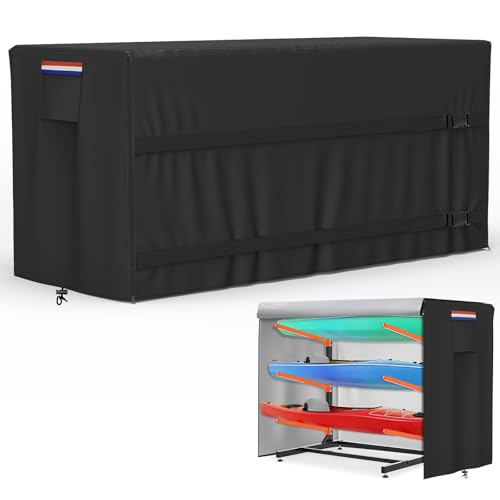
Roasivi Freestanding Kayak Rack Cover

Tough Cover 300D Kayak Cover 11-12ft

Seenelling 2 Pack 600D Cockpit Covers
What Each Pick Brings To The Table
A 14- to 15-foot boat needs protection without becoming a complicated storage chore. This Cypress Rowe Outfitters cover uses an elastic cord in the lower edge, a small-boat-style hem that helps it settle around the hull. That simplicity makes it practical for a garage, yard, or sheltered outdoor position.
Compared with the 16-ounce canvas model later in the lineup, this option presents a lighter-looking, less equipment-heavy approach. The stated sizing focuses on 14- and 15-foot canoes or kayaks, so measuring your craft before ordering is still essential.
Where It Helps
- The elastic lower edge simplifies installation and removal during changing weather.
- Rain, sunlight, and dust protection suit regular outdoor or garage storage.
- The small-boat-style shape suits canoe and kayak profiles up to 15 feet.
- A removable design avoids leaving the cover on constantly during active use.
Worth Noting
- The fit centers on 14- to 15-foot boats, leaving longer craft needing another option.
- Loose debris and trapped moisture still call for occasional cleaning and airflow.
Quick Facts
Made For
You benefit most with a 14- or 15-foot canoe or kayak stored in a garage or modest outdoor space.
Another Choice May Suit
Cypress Rowe Outfitters Nature Proof 16′-18′ Cover suits owners of longer boats that fall outside this model’s range.
This cover takes a more substantial approach than the first Cypress Rowe Outfitters option, using 16-ounce canvas as its central material. That weight suggests a sturdier feel for 13- and 14-foot boats kept outdoors through variable weather. It is a sensible match for owners who value a substantial shell over a minimal design.
The sewn-in elastic cord and straps add control around the hull, which can be helpful in a windy yard. In a tight garage, you may find those same straps need careful routing so they don’t snag nearby objects.
What Stands Out
- The 16-ounce canvas gives the cover a notably substantial construction.
- Elastic and straps help keep the material gathered around the boat.
- Water, sunlight, and dust coverage addresses common storage threats.
- The small-boat-style profile fits a familiar canoe or kayak storage shape.
Trade Offs
- Heavier material can be less convenient for frequent one-person handling.
- Canvas requires attention to trapped moisture during long storage periods.
- Straps add more placement points to check before leaving a boat unattended.
- The 13- and 14-foot focus excludes longer kayaks and canoes.
Who It Suits Best
Outdoor paddlers storing 13- or 14-foot boats benefit from the heavier canvas and combined cord-and-strap restraint.
Where A Sibling Pick Shines
Tough Cover 300D Kayak Cover 11-12ft offers a lighter-weight alternative for shorter recreational kayaks.
Longer boats often have fewer compatible covers, and the Nature Proof model fills that gap with a stated range extending from roughly 15 feet 6 inches through 18 feet. That broader target makes it useful for families storing a long tandem canoe or a full-size touring kayak.
Its adjustable bungee-style elastic and straps are more accommodating than the simpler lower hem on the 14′-15′ Cypress Rowe Outfitters cover. For a long hull, those adjustments can distribute the cover more evenly, though exact fit still depends on the boat’s beam and profile.
What It Does Well
- Coverage spans several common lengths for 16-, 17-, and 18-foot boats.
- Adjustable elastic helps accommodate changing contours along a longer hull.
- Straps offer secondary control for exposed outdoor storage.
- The small-boat-style shape keeps the concept familiar to canoe owners.
Points To Note
- Its length range doesn’t help boats under the lower stated boundary.
- Multiple adjustment points need periodic checks after wind or handling.
Feature Snapshot
Right Fit For
Households with 16- through 18-foot canoes or kayaks get the broadest stated length coverage in this group.
A Better Fit Elsewhere
Cypress Rowe Outfitters 14′-15′ Canoe/Kayak Cover is more directly sized for compact boats outside this longer range.
Whole-vessel covers suit boats resting on the ground, but a stacked rack creates a different problem: one watercraft protects another while rain reaches every layer. The Roasivi model covers the rack as a unit, with room for two to four levels of freestanding storage.
Its 420D silver-coated Oxford fabric and double-layer waterproof construction set it apart from the single-kayak Tough Cover model. One caution is structural: this cover is intended for freestanding racks, not wall-mounted systems.
Good Reasons To Consider
- The enclosure protects multiple stacked kayaks in one setup.
- Silver-coated Oxford fabric provides a substantial weather barrier.
- The double-layer construction adds redundancy for outdoor rack storage.
- Raised dimensions allow coverage around a multi-level freestanding rack.
- Garage placement also suits a dusty storage area with several boats.
Things To Consider
- Wall-mounted racks fall outside the stated application.
- The full enclosure needs enough clearance around the loaded rack.
- Owners commonly inspect a large outdoor cover for trapped leaves and pooled water.
Technical Notes
Built With In Mind
You benefit most with two to four kayaks stacked on a freestanding rack in a garage or yard.
Another Choice May Suit
Seenelling 2 Pack 600D Cockpit Covers suit wall storage where targeted cockpit protection matters more than enclosing an entire rack.
The Tough Cover focuses on a common recreational-kayak size without attempting to cover a larger storage system. Its 11- to 12-foot range suits many fishing, recreational, and sit-on-top kayaks kept on a ground stand or stored in a garage.
Compared with the Roasivi rack cover, this is a simpler one-boat solution. The 300D fabric and reinforced, double-stitched seams add useful durability, while breathable construction helps reduce moisture buildup during longer storage.
Practical Advantages
- The 300D fabric offers a durable middle ground for routine storage.
- Reinforced seams strengthen areas that commonly flex or pull.
- Breathability helps limit condensation beneath the cover.
- Short sizing makes everyday handling more approachable.
Minor Gripes
- Its 11- to 12-foot range leaves many longer kayaks uncovered.
- Water resistance is useful, but it is not the same as a fully waterproof enclosure.
- Dirt and pollen can settle in seams, so periodic brushing and drying help.
Who Should Grab It
Paddlers with an 11- or 12-foot recreational kayak need straightforward coverage for a garage or simple outdoor stand.
Look Elsewhere When
Roasivi Freestanding Kayak Rack Cover serves you better when several kayaks are stacked on a freestanding rack.
Not every storage area needs a full-length cover. Seenelling takes a narrower approach with two 60-by-29-inch cockpit curtains made from 600D nylon, giving you a reusable layer over the opening where dirt, rain, leaves, and bird droppings often collect.
The four adjustable wall straps also make this a credible wall-storage solution. Unlike the full-vessel covers, it leaves most of the kayak exposed, so it works best alongside another storage layer or in a more sheltered location.
What Earns Its Place
- Two covers support multiple kayaks or rotation between wet and dry setups.
- 600D nylon provides a substantial material for a cockpit-sized cover.
- The broad 60-by-29-inch dimensions suit many open cockpits and footwells.
- Wall straps support a space-saving vertical storage arrangement.
Practical Considerations
- Coverage is limited to the cockpit rather than the whole hull.
- Manual measurement helps confirm compatibility with unusual cockpit shapes.
- Loose covers collect debris, so a quick wipe helps maintain a tidy wall.
Core Details
Whose Shelf It Belongs On
You benefit most with wall-stored kayaks whose cockpits need targeted protection from dirt and moisture.
Reach For A Different Pick When
Tough Cover 300D Kayak Cover 11-12ft provides broader whole-boat coverage for an 11- or 12-foot kayak.
Matching Protection To Your Storage Situation
Measure the Boat First
Start with length, width, and the boat’s upper profile. Full-length covers need enough material to overlap the hull without leaving a loose opening, while cockpit covers demand direct measurements of the opening. Compare the manufacturer’s range with your own tape measure rather than relying on the boat’s advertised class.
Match The Cover To The Location
A freestanding rack calls for an enclosure that covers the entire loaded structure. Wall storage may favor a cockpit curtain and adjustable straps, while a kayak resting on supports benefits from a dedicated 11- or 12-foot cover. Exposure matters too, since fabric thickness, water resistance, and ventilation all influence long-term ownership.
Check The Closure System
Elastic hems, bungee cords, and straps work in different ways. Elastic suits relatively simple hull profiles, while straps and multiple adjustment points give longer boats more control. Inspect each fastening after installation, especially in windy locations, and keep hardware clear of sharp rack edges.
Account For Ongoing Care
Outdoor covers need occasional attention regardless of material. Brush away leaves and dirt, let the cover dry fully, and check for standing water after wet weather. Breathable fabric can reduce condensation, yet a dry, ventilated storage position remains the simplest long-term safeguard.
Small Choices That Prevent Storage Headaches
Common Shopping Slip Ups
Length is the most consequential measurement, but beam and storage hardware matter just as much. Confirm the cover suits your rack type, ground supports, or wall setup instead of assuming every outdoor location is compatible. Cockpit covers also need direct measurement because unusual seat openings may not match the nominal size.
What Separates Premium From Basic
Higher fabric weights can add durability, while coated or multi-layer construction can improve weather resistance. Reinforced seams, broader adjustment systems, and enclosure around an entire rack are also meaningful upgrades. The extra material matters most for exposed storage, frequent handling, or multiple watercraft rather than occasional indoor use.
Frequently Asked Questions
What size kayak cover should you choose?
Choose one that matches the boat’s full length and covers its width and upper profile. Also account for supports, racks, straps, and any cockpit-specific dimensions.
Is a waterproof cover better than a water-resistant one?
A waterproof construction offers a stronger barrier during sustained exposure. A water-resistant, breathable cover may still work well in sheltered areas with regular drying and maintenance.
Can you use a kayak cover indoors?
Yes, indoor covers remain useful against dust, pollen, dirt, and incidental contact. Indoor placement may also reduce weather exposure and lengthen fabric life.
Are cockpit covers sufficient for outdoor storage?
Cockpit covers provide targeted protection but leave most of the kayak exposed. A full-vessel cover or sheltered storage position offers broader protection for long-term outdoor use.
How often should a stored kayak cover be checked?
Check it after storms, strong wind, or nearby construction. Periodic inspections help you clear debris, pooled water, loose straps, and any early fabric wear.
Final Verdict
Your best match depends on the boat and storage setup more than the label. Cypress Rowe Outfitters serves several canoe and kayak lengths, Roasivi handles stacked racks, Tough Cover targets shorter recreational kayaks, and Seenelling focuses on wall-stored cockpits. Measure first, then choose the coverage that fits your actual storage life.
