

A backyard trail camera can show you which animals cross the fence after dark, visit a feeder, or spend time near a garden. The right model balances responsive capture, dependable power, and the connectivity you actually need, rather than turning your outdoor space into another maintenance project. These Backyard Wildlife Cameras suit backyard wildlife watchers, hunters, property owners, and anyone who wants clearer evidence of outdoor activity without constantly checking a physical display.
A Side-By-Side Look

WIMIDING Cellular Solar Trail Camera 64MP 2K

GardePro X66 Pro Cellular Trail Camera
Moultrie Edge 3 2-Pack

Moultrie Edge 3 Camera

Moultrie Edge 3 Solar Camera

OUTDOOR EXPERT Mini Camera 2-Pack
More Details On Our Top Picks
Remote monitoring usually presents a choice between local recording and cellular access, but this WIMIDING model lets you use either. Its removable SIM card means the camera can operate as a conventional trail camera without a data plan, which suits remote corners with weak reception. Live streaming becomes the practical addition rather than a requirement.
The solar and rechargeable power arrangement is useful for a tree beside a backyard game trail. Compared with the networked Moultrie models, this pick offers more control over how the connection is used, although setup and cellular-service compatibility deserve careful review.
Where It Delivers
- The 64MP still-image mode provides detailed views of backyard visitors.
- 2K video capture adds useful detail to movement near feeding areas.
- Night vision supports observation after sunset.
- Solar charging reduces routine battery replacement in suitable locations.
- A removable SIM allows local operation without cellular service.
Points To Keep In Mind
- Live viewing and cellular transfers require a working connection and suitable service.
- Solar performance depends on placement, tree cover, and seasonal sunlight.
- Outdoor cameras commonly need occasional checks for rain, sap, or dirt around the housing and lens.
Key Specs
Right Fit For
This model benefits rural and suburban watchers who need local capture during cellular outages or simply prefer not to depend on a data plan.
Where A Sibling Pick Shines
Choose the Moultrie Edge 3 Camera instead for automatic connection across major U.S. carrier networks.
The GardePro X66 Pro focuses on maintaining a connected backyard trail system across several locations. Live View, on-demand HD requests, and uploaded files depend on an active data plan, so cellular cost belongs in the ownership calculation. Multiple cameras can share usage under one account, which makes the setup easier to manage as coverage expands.
A rechargeable, replaceable battery pack gives you another way to service the camera without replacing the entire unit. Unlike the WIMIDING’s plan-free local option, the X66 Pro is designed around connected monitoring, making it more suitable for households that regularly check activity from a phone.
Key Advantages
- Shared plans simplify management across several deployed cameras.
- Monthly and annual service options offer scheduling flexibility.
- The replaceable battery pack supports routine maintenance.
- Live View helps you check a yard before making a trip outside.
Small Caveats
- Photo uploads, live viewing, and on-demand HD require active cellular service.
- A battery change still requires you to access the mounting location.
- High trees or fences can complicate physical maintenance even when remote viewing is convenient.
- Outdoor housings may collect moisture or insects and need regular visual inspection.
Who Will Love This
This choice suits connected households managing one or more cameras across a larger property.
Another Choice May Suit
The WIMIDING Cellular Solar Trail Camera 64MP 2K is a better fit for locations that cannot depend on cellular coverage.
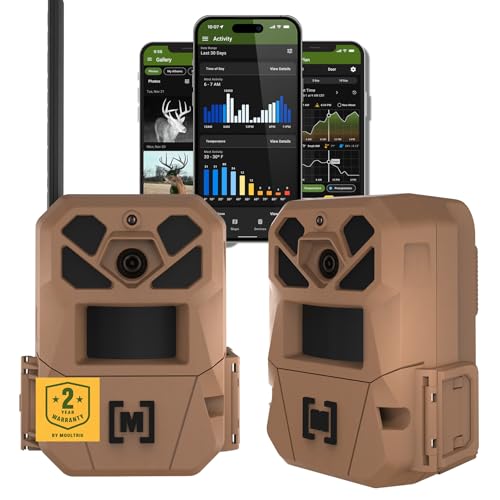
Two cameras can turn a single monitoring point into a useful map of your yard. The Moultrie Edge 3 2-Pack lets you place one camera along a fence line and another near a wooded feeding area, which reduces blind spots without requiring two separate model decisions.
A 0.5-second trigger is the standout detail for fast movement, while 40MP stills provide detailed records for wildlife identification. The camera also automatically connects across four national networks, a practical advantage over systems that require manual SIM or network changes.
Strong Points
- Two cameras provide broader coverage across separate backyard zones.
- The 0.5-second trigger suits deer, pets, and other quick-moving animals.
- 40MP images preserve useful detail for later identification.
- Automatic selection across major carrier networks reduces connection setup.
Trade-Offs
- Two devices require a cellular plan for connected uploads and viewing.
- Mounting two cameras means twice the tree, strap, and access checks.
- Network reception can weaken beneath dense canopy or near metal structures.
- You may end up with more footage than routine card checks can accommodate.
Feature Snapshot
Built With In Mind
Homeowners monitoring wooded edges, gardens, and game crossings benefit from the balanced placement offered by two cameras.
A Better Fit Elsewhere
The OUTDOOR EXPERT Mini Camera 2-Pack is easier to carry and position in tight or frequently changed locations.
A single well-placed camera often solves the basic need: showing what crosses a familiar backyard route. This Moultrie Edge 3 Camera combines 40MP still capture with a 0.5-second trigger, which matters for animals that cross a gap quickly during dawn or dusk.
Automatic connection across four major network types is the more important feature for many outdoor locations. Compared with the two-pack, this version is easier to manage for one feeding station or property entrance, though its data plan and physical placement still deserve attention.
Useful Strengths
- Fast trigger timing supports concise records of moving wildlife.
- 40MP photographs make distant subjects easier to examine.
- Automatic network connection avoids manual SIM selection.
- One-camera deployment keeps placement and maintenance simple.
A Few Limitations
- Connected uploads and remote viewing depend on cellular service.
- A single unit cannot cover two separated sight lines.
- Tree limbs can obstruct the sensor or trigger in changing weather.
- Dense foliage may reduce usable signal and nighttime illumination.
Made For
Focused wildlife watchers monitoring one high-traffic area will find the single-camera format easier to maintain.
Consider Something Else When
Property owners covering a front yard and wooded boundary should favor the Moultrie Edge 3 2-Pack.
Remote placements become easier to service once the camera can draw sustained power from sunlight. The 3.4W solar pack pairs with the Moultrie Edge 3’s 40MP capture and quick trigger, making it a practical choice for a fence post or open woodland edge beyond easy power access.
Solar assistance reduces charging interruptions, but it does not make placement irrelevant. The panel needs an unobstructed view of daylight, and a camera beneath thick tree cover may still require regular battery attention. Compared with the single-camera Edge 3, the added hardware favors long-term remote monitoring.
Positive Points
- The 3.4W solar panel supports routine off-grid charging.
- 40MP stills preserve detail in backyard wildlife records.
- The quick 0.5-second trigger suits animals crossing quickly.
- Four-network automatic connection simplifies cellular use.
- Remote power reduces the need for frequent physical access.
Details To Watch
- Shade and heavy cloud cover can reduce solar contribution.
- The panel requires an open position that suits the camera’s view.
- Dirt on the panel and lens can lower practical performance.
Technical Reference
Whose Shelf It Belongs On
This solar version suits property owners placing a connected camera in a sunny area far from an outlet.
Reach For A Different Pick When
Choose the Moultrie Edge 3 Camera for a simpler single-camera setup without a visible solar assembly.
Mounting space and weight matter more than people expect on fences, young trees, and narrow property edges. The half-hand-size OUTDOOR EXPERT cameras are easy to carry and position, and the two-pack lets you establish separate points without carrying one device back and forth.
Motion activation directs recording toward detected movement, while night vision extends monitoring after dark. The 20MP photo and HD video modes provide useful backyard detail, but these compact local cameras lack the cellular features that distinguish the WIMIDING, GardePro, and Moultrie choices.
Everyday Wins
- The small size suits trees, fences, trails, and portable setups.
- Two cameras provide flexible coverage across separate locations.
- Motion activation avoids unnecessary recording of a fully static scene.
- Night vision supports monitoring after sunset.
- Photo and video modes provide useful recording options.
Less Ideal Details
- Cellular connection and remote viewing are not listed as core functions.
- Low power use can still require battery servicing, depending on activity.
- Compact housings need regular checks around seals, moisture, and insect debris.
- HD video may offer less detail than the 2K-capable WIMIDING model.
Quick Facts
The Right Fit
Compact cameras suit campers, hobbyists, and homeowners who need portable local monitoring in tight outdoor spaces.
Look Elsewhere When
Remote phone access is essential for your setup, making the GardePro X66 Pro Cellular Trail Camera the more practical choice.
What Matters Most Before You Deploy
Start with how you will actually monitor activity. A local camera works well for someone willing to retrieve storage cards or visit the camera regularly, while a cellular model suits remote placements and phone-based checks. Measure the viewing area before choosing a mount, and consider whether foliage, fencing, or buildings will block the intended scene.
Power choice should follow placement. Solar-assisted models reduce charging frequency in open sunlight, yet they still need seasonal checks and clean panels. Indoor storage space, battery access, and the height of your mounts all affect long-term maintenance more than many shoppers initially expect.
Image speed and resolution serve different purposes. A short trigger time helps with deer, pets, or animals moving quickly, while higher-resolution stills make distant subjects easier to identify. Night vision matters after sunset, particularly near gardens, driveways, and wooded boundaries.
Cellular coverage deserves a real-world check. Carrier claims describe potential service, not signal at a specific tree or fence. Placement near metal structures or beneath dense canopy can weaken reception, making a local-recording fallback valuable for remote corners.
Practical Lessons Before You Choose
Mistakes Worth Dodging
Choosing resolution without checking the intended distance can leave you paying for detail the scene does not use. Measure the sight line first, and confirm that a camera can be serviced without a ladder every time its power or storage needs attention.
Where The Extra Money Goes
Higher-cost cellular systems often add network handling, remote viewing, and flexible power options. That spending makes sense for large properties or hard-to-reach cameras, while a compact local pair can be more sensible for simple backyard coverage.
Frequently Asked Questions
Do cellular backyard wildlife cameras work without a data plan?
No. Cellular uploads, live viewing, and on-demand requests generally require active service, though some models can also record locally.
Is a faster trigger important for backyard animals?
Yes. A 0.5-second response can improve the chance of capturing deer, pets, or other wildlife that passes through quickly.
Do solar trail cameras work in every location?
They work best with useful sunlight and an unobstructed panel. Shade, heavy cover, and seasonal weather can reduce their charging contribution.
Are compact trail cameras less durable?
Size alone does not determine durability. Housing material, seals, mounting position, and regular maintenance matter more, especially in wet or dusty locations.
Should you use one camera or a two-pack?
A two-pack covers separate zones and reduces blind spots. One camera is easier to maintain and works well when a single sight line provides enough information.
Final Verdict
Your best fit depends on power access, viewing distance, and how much remote control you need. The Moultrie models lead for responsive cellular capture, the WIMIDING adds solar flexibility and local use, and the OUTDOOR EXPERT pair favors compact placement. Choose for the way you will use the camera, then give the mounting position the attention it deserves.
