

Outdoor TV reception becomes less of a gamble once you account for tower distance, terrain, building materials, and the direction your local stations broadcast. A rotating antenna can help households chase a stronger signal without repeatedly climbing onto a roof, while an indoor model offers a simpler setup for apartments and nearby stations. These picks cover outdoor rotation, remote-controlled positioning, flexible indoor placement, and a mounting accessory for creating a higher outdoor installation.
The Choices Worth Comparing

Five Star 55-Inch Universal Adjustable Mounting Pole
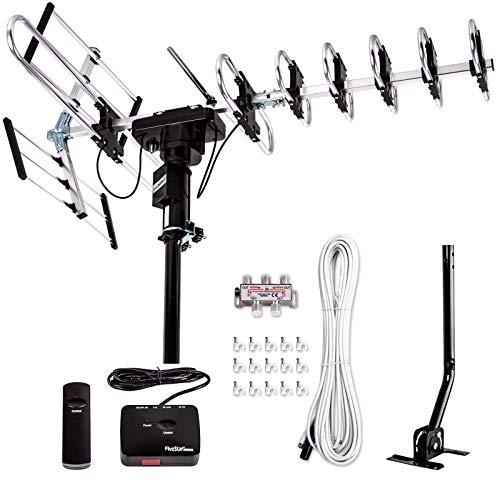
Five Star 200-Mile Outdoor Amplified Antenna, 360-Degree

CEKAY 150-Mile Motorized Outdoor Antenna with Remote

Arrasolt Melas 6000+ Mile Indoor Outdoor Antenna

Five Star Ultra-Thin Amplified Indoor Antenna, 60-Mile
YiziAifsion 2026 Indoor TV Antenna, 25ft Cable
Inside Each Recommended Option
This is a mounting accessory rather than an antenna, but it solves a real part of rooftop setup. Its 55-inch mast, 39-inch support legs, and three-point galvanized structure can lift antennas, dishes, weather stations, or Starlink equipment above obstructions without replacing the receiving device itself.
You’ll get more freedom to adjust height and tilt on a sloped or ridged rooftop, provided the mounting surface can support the assembled load. Compared with the antenna picks that follow, it offers no reception gain of its own, so you still need a compatible outdoor device.
What Helps Most
- Height adjustment helps you move receiving equipment above nearby rooflines.
- Tilt adjustment supports more accurate directional alignment for directional devices.
- The galvanized finish suits exposure to ordinary outdoor weather.
- Included hardware reduces the need to source a separate mounting kit.
Practical Considerations
- Roof work still requires careful anchoring and safe access.
- Galvanized steel needs occasional inspection for looseness, dirt, and surface wear.
Core Details
Built With In Mind
Homeowners with safe roof access and a compatible outdoor antenna benefit most from this accessory.
Another Choice May Suit
Choose the CEKAY 150-Mile Motorized Outdoor Antenna with Remote instead when remote positioning matters more than a taller mounting structure.
Far from a crowded city block, this outdoor amplified antenna gives you both broad VHF and UHF reception plus manual directional positioning. A 360-degree rotation helps you aim the antenna toward different broadcast groups, while the included installation kit and mounting pole make it more relevant to a full rooftop setup than the indoor choices later in the list.
The listed 200-mile reach is a maximum capability rather than a promise for every location. Terrain, tower distance, foliage, and nearby buildings still matter, so you may need patience during channel scanning.
What Stands Out
- Manual rotation lets you aim reception toward multiple station directions.
- The amplifier supports reception where signals travel farther or arrive weaker.
- Five-TV support makes it suitable for larger households with several sets.
- VHF, UHF, and FM reception broaden its usefulness beyond one channel group.
- The included kit reduces separate accessory planning for a basic installation.
Things To Consider
- Its outdoor scale and cable routing call for a secure, accessible mounting point.
- Amplification cannot replace a clear line of sight to broadcast towers.
- You’ll need to rescan channels after major direction changes.
Key Specs
Made For
Rural households seeking outdoor reception, several televisions, and broad band coverage benefit most.
Reach For A Different Pick
The CEKAY 150-Mile Motorized Outdoor Antenna with Remote is better for roofs where powered remote rotation saves repeated manual adjustments.
Powered rotation changes the ownership experience for an outdoor antenna. You can turn the CEKAY toward a different broadcast group with its remote, which is especially useful after rain, seasonal foliage changes, or a scan reveals that stations sit in several directions.
The 40-foot RG6 cable provides a useful route from a high outdoor position to televisions inside the home. Compared with the Five Star 200-Mile Outdoor Amplified Antenna, 360-Degree, you trade manual positioning for motor-driven convenience rather than gaining a clearly higher stated ceiling.
The Helpful Details
- The remote makes directional tuning possible without roof access.
- A low-noise amplifier helps strengthen weaker signals and limit interference.
- The 40-foot RG6 cable reaches from many outdoor mounting positions into the house.
- Smooth powered rotation gives you controlled movement in either direction.
Small Caveats
- The motor and wiring require a weather-conscious outdoor installation.
- Owners may need to rescan channels after each meaningful repositioning.
- The claimed 150-mile reception still depends heavily on line of sight.
Technical Sheet
Right Fit For
You benefit most with safe roof access, several station directions, and a preference for remote adjustment.
Swap It Out When
The Five Star 200-Mile Outdoor Amplified Antenna, 360-Degree fits households wanting a higher stated reception range and support for five televisions.
Placement flexibility is the central benefit here. You can start with this antenna indoors, move it near a window, or place it outdoors depending on signal access, which makes it a practical option for renters who cannot begin with a rooftop installation.
Its listed 6000+ mile range should be treated as a headline capability, not a realistic expectation in every home. The honest read is that stations, obstructions, and broadcast infrastructure matter more than a large range number.
Notable Gains
- Indoor and outdoor use gives you two installation paths.
- A compact initial setup suits apartments, rentals, and single-room televisions.
- Local broadcast reception can replace routine channel use without recurring TV service fees.
Honest Caveats
- The product lacks the motorized positioning offered by the CEKAY antenna.
- You may need to relocate it room by room before finding a stronger signal.
- Outdoor placement requires suitable weather protection and secure cabling.
Who It Suits Best
You benefit most as a renter or apartment resident who wants to test an indoor setup before touching a roof.
Consider Something Else When
The Five Star Ultra-Thin Amplified Indoor Antenna, 60-Mile offers a more deliberate indoor design for homes where appearance and foldable storage matter.
A fabric-wrapped, ultra-thin profile makes this indoor antenna easier to live with than a conspicuous electronic panel in a living room. You can place it against a wall or near a window, then fold the structure for storage in a closet or cabinet.
The high-gain amplifier supports reception across VHF and UHF channels, and the listed 60-mile capability suits homes within a moderate radius of broadcast towers. Apartments with thick masonry may still receive a stronger result from the Arrasolt Melas model, depending on where your local transmitters sit.
Strong Points
- The fabric finish blends more naturally into a modern living space.
- Its foldable body makes storage and repositioning simple.
- Wall and window mounting gives you two practical placement choices.
- The amplifier supports both VHF and UHF broadcast reception.
- Its slim profile leaves a television shelf or desktop less cluttered.
Details To Watch
- You’ll need to experiment with placement to find a stronger indoor signal.
- Fabric can collect dust and may need occasional light cleaning.
Feature Snapshot
Whose Shelf It Belongs On
You benefit most in a smaller home or apartment where visible equipment, folding, and simple placement are priorities.
Look Elsewhere When
The Arrasolt Melas 6000+ Mile Indoor Outdoor Antenna better suits you because it can move from an indoor trial to an outdoor location.
The 25-foot lead gives a television more freedom than a short fixed cable, letting you place the antenna near a higher window or on another side of the room. That flexibility is useful for smart TVs in bedrooms, kitchens, and other secondary viewing areas.
Its listed 6500+ mile range is an expansive claim, but indoor placement still sets the practical limit. The YiziAifsion works best as a straightforward indoor option, not as a substitute for a directional outdoor model in difficult reception areas.
What Pays Off
- The extended cable improves your options for indoor antenna placement.
- A simple indoor format suits apartments and secondary televisions.
- You can move the unit between rooms while channel testing.
Possible Compromises
- You’ll need to rescan after moving it to a different part of the home.
- The cable requires careful routing to avoid bends or pinches.
- Thick concrete and metal-heavy buildings may weaken reception.
Who Will Love This
You benefit most for a bedroom or kitchen TV near local transmitters and a room with a suitable window.
Where A Sibling Pick Shines
The Five Star Ultra-Thin Amplified Indoor Antenna, 60-Mile better suits you when a foldable fabric design and understated appearance carry more weight.
Choosing an Antenna That Fits Your Home
Start with the broadcast terrain
Range claims give you a rough scale, but tower location and line of sight determine real reception. Rural homes may face greater distance, while apartments can lose signals through concrete, metal framing, and reflective glass. Note the direction of local broadcast towers before choosing a directional or rotating design.
Choose rotation for difficult layouts
A 360-degree antenna turns around a central axis so you can face different sides of your home. Manual rotation is straightforward, while a motor and remote save repeated roof access. The CEKAY model is especially helpful for mixed station directions, although a power connection must reach the outdoor unit.
Match placement to the room
Indoor antennas work best near an exterior wall or window, but you may need to move them after scanning channels. The YiziAifsion 25-foot cable adds placement range, while the Five Star fabric model folds neatly away in compact living spaces. Outdoor installation offers fewer building losses but requires secure mounting and cable routing.
Plan the entire installation
Check the included mast, pole, hardware, and cable length before climbing a roof. A separate distribution system may be needed for multiple televisions, and splitters can weaken signals. Regular inspections also help you detect loose fasteners, worn cable insulation, or water collecting around connections.
Common Mistakes Worth Avoiding
Mistakes Worth Dodging
A huge stated range does not overcome hills, trees, concrete, or a distant tower. Compare the antenna’s supported frequency bands and placement limits with your local stations. Choosing a complex rooftop model for a nearby indoor signal often adds installation work without a meaningful benefit.
What Separates Premium From Basic
Higher-tier outdoor models may add powered rotation, stronger amplification, longer cable, a mast, or multi-TV distribution. Those features matter most for difficult terrain or several televisions. A compact indoor setup is enough for many homes, so paying extra for remote rotation makes little sense near a strong transmitter.
Frequently Asked Questions
Do 360-degree outdoor antennas receive every channel?
No. Reception depends on distance, terrain, obstructions, station direction, and your television’s tuner. Rotation can help you aim at available stations, but it cannot guarantee coverage everywhere.
Can one outdoor antenna serve several televisions?
Some models support multiple televisions, including the Five Star 200-Mile Outdoor Amplified Antenna, 360-Degree. Distribution splitters and sufficiently strong signals remain important, as each added split can reduce signal quality.
Are larger range claims always better?
Not necessarily. Tower placement and a clear path to transmitters can matter more than the largest number on a listing. An indoor model may work well in a favorable building, while a distant rural household may need outdoor height and directional control.
Can indoor antennas be mounted near windows?
Yes, but glass, screens, and metal frames can weaken signals. You’ll usually get better results near an uncovered exterior wall, and channel scans after each position change help reveal which placement works best.
Do motorized antennas need power?
The CEKAY motorized model requires its motor to receive electrical power. Plan a safe outdoor connection, secure the cable route, and follow local electrical requirements during installation.
Wrap Up
Choose based on your actual reception problem, not the largest range number. You need a taller outdoor system for distant or obstructed stations, remote rotation for mixed directions, or a compact indoor antenna for a nearby transmitter and flexible placement. Once signal direction, cable length, and room location are clear, the right choice becomes much easier.
