

Cheap night vision monoculars can make backyard wildlife watching, nighttime hiking, and campsite observation far easier. The hard part is separating true infrared or thermal devices from cosmetic props and separating useful outdoor performance from marketing-heavy listings. I focus on magnification, illuminators, recording, controls, dimensions, battery information, and intended use so the final choice matches the actual situation.
The roundup includes six functional monoculars, one compact thermal unit for heat-based detection, and one nonfunctional PVS-style prop reserved for cosplay. I distinguish image intensifiers, digital infrared devices, and thermal sensors because each creates visibility through a different mechanism. That distinction matters before spending money on equipment meant for hunting, travel, property checks, or display use.
A Fast Comparison Of The Options

FLIR Scion OTM130 Thermal Imaging Monocular

ATN OTS XLT Thermal Monocular

WoSporT PVS15 Dummy Night Vision Goggles

TakLite IRIS Digital Night Vision Monocular

GTGUARD B210AL Touchscreen Thermal Monocular

YUANZIMOO 8X Digital Infrared Monocular
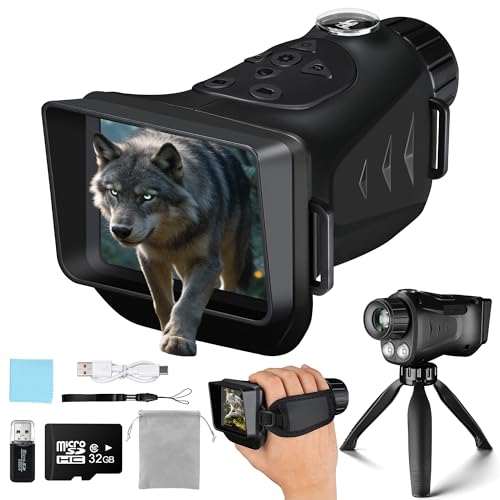
VXF Night Vision Monocular for Wildlife

Sheawasy 1080p Infrared Monocular 32GB
More Details On Our Top Picks
The Scion OTM130 detects infrared heat rather than simply brightening visible light, making it useful around dawn, dusk, and complete darkness. For wildlife watching, that thermal contrast can separate a warm animal from vegetation and cold terrain, although the 227 mm length feels substantial for long hikes.
Its OLED display, picture-in-picture zoom, and adjustable thermal palettes suit someone who wants more observation tools than a basic digital monocular provides. Compared with the later GTGUARD B210AL, the FLIR emphasizes recording and established imaging hardware, but the touchscreen convenience is less prominent.
Notable Gains
- Boson thermal core reveals temperature contrast without visible illumination.
- Internal and microSD storage preserve still images and video.
- GPS functions add location context to recorded encounters.
- Picture-in-picture zoom helps retain a wider view beside a magnified area.
Things To Consider
- The long housing may tire handheld users during extended walks.
- Lens and housing care matter outdoors because dirt and moisture can reduce image clarity.
Key Specs
Who It Suits Best
This model best suits wildlife observers and property monitors who value thermal contrast and geotagged recording over pocketability.
A Better Fit Elsewhere
The ATN OTS XLT Thermal Monocular is the lighter choice for mobile wildlife observation.
The ATN weighs 0.8 pound, a meaningful change from the bulkier FLIR Scion OTM130. That portability matters on a dawn patrol around a property or during a camping trip where every extra ounce accumulates across uneven ground.
Its 50 Hz refresh rate updates the thermal view 50 times per second, which is more responsive than many entry-level thermal devices intended for static subjects. In my view, the smart rangefinder and simple controls make this a more useful field tool, although tree cover, humidity, and distance still affect useful range.
Standout Benefits
- The 0.8-pound body reduces fatigue during mobile observation.
- A 50 Hz refresh rate handles moving subjects more smoothly.
- Color and monochrome palettes suit changing viewing conditions.
- Rangefinder support helps estimate target distance.
Small Caveats
- Thermal palettes may require adjustment for a new scene.
- The pocket-friendly claim may be less convincing with added storage or accessories.
Technical Highlights
Made For
Mobile wildlife watchers benefit most from its low weight, responsive thermal view, and straightforward controls.
Consider Something Else When
The FLIR Scion OTM130 is the stronger match for recordings that benefit from internal storage and GPS.
This dual-tube model provides no imaging capability whatsoever, so it belongs in a cosplay category rather than with functional night vision equipment. Its realistic PVS-style shell works for conventions, costume photography, film props, and helmet-mounted displays where only outward appearance matters.
ABS plastic helps keep the prop lighter than a full electronic assembly, while the stated 1:1 proportions support accurate costume planning. Compared with every functional monocular here, the distinction is absolute: nothing recorded or amplified through this display can help me see at night.
A Favorable Mix
- Dual tubes closely imitate PVS-style equipment.
- Lightweight ABS construction suits extended wear during conventions.
- Helmet compatibility supports military-inspired costume setups.
Where It May Fall Short
- It has no sensor, display, illuminator, or optical function.
- Regular lens and housing maintenance is still relevant during transport and storage.
The Right Fit
Cosplay participants and prop collectors benefit most from its accurate appearance and helmet-ready form.
Look Elsewhere When
The TakLite IRIS Digital Night Vision Monocular is the appropriate choice for actual nighttime observation.
The IRIS favors natural scanning over distant magnification. A fixed 1X view and 60-degree field of view reduce the constant refocusing associated with narrow devices, which is useful for walking trails, watching a yard, or maintaining awareness of nearby movement.
Its 940nm illuminator provides invisible infrared light, while the OLED display presents the captured scene digitally. The sub-10ms latency and 60 FPS playback favor fast movement, making this a practical alternative to the FLIR and ATN for people who prioritize a broad view rather than heat signatures.
The Good Stuff
- The wide 60-degree field simplifies navigation and close observation.
- Latency below 10 ms helps keep fast movement visually current.
- Infrared illumination supports low-light scenes without a visible lamp.
- Handheld and head-mounted use broadens mounting preferences.
Worth Noting
- Fixed 1X magnification offers little detail for distant subjects.
- Dust and lens smudges become noticeable during broad low-light scans.
Feature Snapshot
Who Will Love This
Nighttime hikers and close-range wildlife watchers benefit from the wide, low-latency view.
Another Choice May Suit
The GTGUARD B210AL Thermal Monocular suits distant heat-signature observation better.
The B210AL combines thermal detection with a 2.16-inch full-color touchscreen, reducing the need to navigate small physical buttons. That design makes it approachable during a nighttime property check, though gloves may reduce touchscreen convenience in cold weather.
Its 10mm f/1.0 lens gathers light through a wide aperture, which supports the listed 656-yard detection and ranging capability. The stated 1.1-yard ranging accuracy adds useful scale at open sites, but foliage, fog, and thermal contrast can change how readily a subject appears.
A Few Strong Suits
- Touch controls simplify palette and ranging access.
- Long stated detection range suits open fields and clear edges.
- The color screen presents thermal data in a readable format.
- Measured ranging adds context beyond simple detection.
Potential Compromises
- The large screen makes the unit less compact than the ATN.
- Touchscreens can be less responsive with wet or gloved fingers.
- A soft lens cloth helps control fingerprints and outdoor smudges.
Core Details
Built With In Mind
Property monitors and open-land wildlife spotters benefit from its ranging and touchscreen controls.
Swap It Out When
The TakLite IRIS is the better fit for close-range scanning where a wide field matters more.
The YUANZIMOO package centers on useful camping accessories: an 8X digital view, a rechargeable 2000mAh battery, tripod, 32 GB SD card, and card reader. That combination is appealing for someone setting up a stationary campsite observation point without assembling separate gear.
Seven 850nm infrared levels and a 1.3-megapixel CMOS sensor provide several illumination choices for changing darkness. Unlike the thermal options, this is digital night vision, so nearby objects may retain useful detail while distant image quality can vary with available infrared light.
The Upside
- Eight-power magnification helps isolate distant subjects.
- Seven infrared levels accommodate different outdoor conditions.
- The tripod reduces shake during stationary observation.
- Included storage eliminates the need to add a card initially.
Details To Watch
- Digital zoom can soften fine detail at maximum magnification.
- Long sessions require periodic battery and card management.
- Tripod components add bulk for travelers.
Quick Facts
Best Suited To
Campers and stationary wildlife spotters benefit most from the tripod, storage card, and adjustable infrared levels.
Where A Sibling Pick Shines
The ATN OTS XLT is the stronger fit for lightweight thermal observation of moving subjects.
Two 850nm infrared illuminators give the VXF more lighting options than a single-lamp arrangement, while three infrared filter levels help adapt the image to different surroundings. For a forest edge or open property, that flexibility is more useful than a dense list of secondary controls.
The claimed 100-meter wildlife visibility and 100-to-200-meter observation of people or buildings make it seem oriented toward moderate-distance scouting. 4K UHD video recording is a separate advantage over the VXF’s bare-bones role as a viewer, though storage limits and actual scene contrast deserve attention.
Bright Spots
- Dual illuminators widen nighttime lighting options.
- Three filter levels suit changing ambient conditions.
- 4K UHD recording preserves outdoor observations.
- Wildlife-focused settings suit forest-edge monitoring.
Practical Considerations
- Claimed visibility varies with terrain, vegetation, and infrared reflection.
- Recording storage needs checking before extended outings.
- Illuminators consume battery during sustained darkness.
Whose Shelf It Belongs On
Forest campers and suburban wildlife observers benefit from adjustable illumination and video capture.
A Better Fit Elsewhere
The FLIR Scion OTM130 is the stronger fit when heat-based detection matters more than a digital recording kit.
The Sheawasy combines 1080p infrared imaging with 32 GB of internal storage, reducing the need to prepare a separate memory card before a trip. That simplicity suits campsite monitoring, travel security checks, and wildlife viewing where a compact recording setup is more important than thermal ranging.
The stated storage allows up to 3.5 hours of video, a useful figure for short outings, although longer sessions need close attention to remaining capacity. Compared with the VXF, its headline emphasis is simpler 1080p capture, while the VXF offers dual illuminators and three infrared filter levels.
The Helpful Details
- 1080p infrared video creates a practical digital record.
- Included 32 GB storage supports immediate recording.
- Darkness-focused imaging suits campsite and travel checks.
- Compact storage simplifies packing and organization.
Room For Improvement
- The listed 3.5-hour capacity is limited for extended monitoring.
- Digital image quality depends on available infrared illumination.
- Keep the lens covered during transport to reduce dust and scratches.
Who Should Grab It
Travelers and casual campers benefit from 1080p recording with storage already included.
Reach For A Different Pick When
The VXF Night Vision Monocular is the better fit for adjustable infrared viewing and longer-range forest observation.
What Matters Most Before Choosing
Image technology: Digital infrared monoculars amplify reflected infrared light, while thermal devices detect heat differences. Digital units often work well for close subjects and general night viewing, whereas thermal sensors can separate warm wildlife from a dark background.
Magnification and field of view: 1X provides a natural view for walking, while 8X makes distant subjects larger but narrows the field and can amplify shake. Head-mounted movement also affects comfort, so fixed 1X models may feel easier during active hikes.
Illumination and recording: An infrared illuminator adds invisible light, but the wavelength, power, and range determine useful reach. Recording capacity matters for campsite monitoring, and included storage saves setup time.
Outdoor handling: Weather resistance, battery charging, tripod support, and lens protection shape the ownership experience. Keep infrared lenses away from bright direct light and clean them with a suitable soft cloth.
Common Mistakes Worth Avoiding
Confusing zoom with thermal detection can lead to unrealistic expectations about distant subjects. A thermal monocular may detect a heat signature without resolving fine detail, while digital night vision depends more heavily on illumination and reflected light. Checking storage, mounting options, and battery format prevents a disappointing first outing.
Why Higher-Tier Units Cost More
Higher-tier equipment may add faster refresh rates, larger thermal sensors, better ranging, stronger construction, and more refined controls. Those improvements help with moving animals, distant observation, or long nights outdoors. A basic digital model can still serve casual campsite viewing, but the extra cost belongs where thermal contrast and reliable control matter most.
Frequently Asked Questions
Are digital night vision monoculars suitable for wildlife watching?
Yes, digital infrared models are useful for many wildlife and campsite scenarios. Thermal options are more effective when subtle heat contrast matters.
Is 1X magnification enough for hiking?
For close navigation and nearby subjects, 1X often feels more natural. Higher magnification helps with distant targets but reduces the field of view.
What does thermal imaging detect?
Thermal imaging detects differences in emitted heat and displays them as contrasting colors or tones. It can reveal warm subjects in darkness, haze, and some vegetation settings.
Can a dummy night vision model display images?
No. The WoSporT PVS15 is a nonfunctional cosplay prop with no imaging capability. It is intended only for display and costume use.
Should I choose a monocular with included storage?
Included storage is convenient for travel and casual recording. Check the card capacity and transfer method before relying on it for extended outings.
Final Thoughts
The ATN OTS XLT stands out for portable thermal observation, while the FLIR Scion OTM130 offers a broader recording-oriented feature set. TakLite IRIS makes sense for wide scanning, and the digital options serve campers more directly. Choose by scene, viewing distance, and recording needs rather than by the largest number on the box.
